
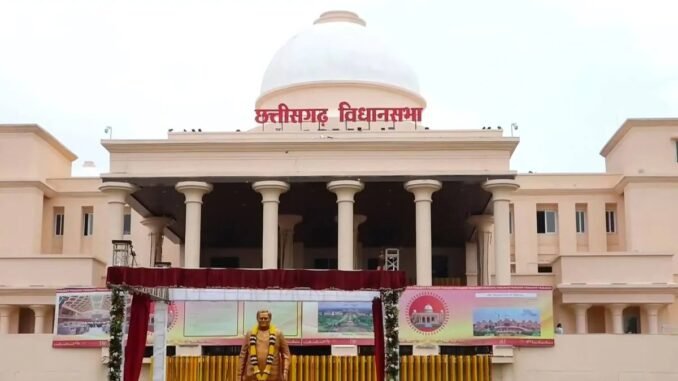
Assembly Clears Landmark Business Reform Bill, Chhattisgarh Introduces India’s First Risk-Based Regulatory Framework
New law aims to reduce compliance burden, speed up approvals, and create a more competitive environment for industries and MSMEs.
Raipur: In a significant policy shift designed to strengthen the state’s industrial ecosystem, the Chhattisgarh Legislative Assembly has approved the Chhattisgarh Ease of Doing Business Act, 2026. With the passage of the legislation, Chhattisgarh has become the first state in India to formally adopt a Risk-Based Regulatory Framework for businesses.
The reform moves away from the traditional one-size-fits-all regulatory approach by introducing differentiated compliance requirements based on the level of operational risk. Officials believe the new framework will improve efficiency, attract fresh investment, and make government services more predictable for entrepreneurs.
Compliance Based on Risk Profile
Instead of subjecting every business to identical procedures, the Act classifies enterprises according to their risk category. Low-risk establishments will benefit from simplified approvals and fewer compliance requirements, while regulatory focus will remain on sectors with higher operational risks.
Trust-Based Governance Model
A major feature of the legislation is the introduction of self-certification, allowing eligible businesses to certify compliance without undergoing repeated inspections. Third-party certification by authorised professionals has also been recognised under the new framework, helping reduce procedural delays.
Simplified Licensing System
The Act also seeks to minimise regulatory paperwork by removing the requirement for annual renewal of licences and permits in several categories. This is expected to lower compliance costs, particularly for MSMEs and start-ups.
Time-Bound Public Services
During the first phase, 43 government services from eight departments will be covered under the legislation. Entrepreneurs will receive faster access to services such as building approvals, water connections and industrial registrations. The law also provides for deemed approvals where departments fail to decide applications within the prescribed timeline.
Institutional Oversight
Implementation of the Act will be monitored through a three-level governance structure comprising an Executive Council, a State-Level Committee, and District-Level Committees to ensure accountability and effective execution.
Expected Economic Impact
Officials estimate that nearly 1.5 million MSMEs across the state will benefit from the reforms. By reducing compliance costs, encouraging digital governance, and introducing a transparent approval mechanism, the Act is expected to strengthen Chhattisgarh’s position as an emerging investment destination.
Business Insight:
The legislation marks a transition from an inspection-heavy regulatory system to a modern governance model driven by risk assessment, trust, technology, and time-bound service delivery—an approach expected to improve both investor confidence and administrative efficiency.
Tags: